
I found myself walking around Ávila this morning in the very early hours, before most people were stirring. Shortly into my walk, an illuminated sign outside a farmacia told me that the time was 06.33 and the temperature was 2°C. If I’d had any kind of a brain at all, I would have been tucked up in bed, but Trinny and I were in Ávila for just one night and I wanted to get a feel for the place without the distraction of the visitors. I figured that walking alone on cobbled streets before dawn might be something to savour, and so it proved to be. Apart from one man, unsteady on his feet and likely making his way home to bed, I had the sleeping town to myself.
Ávila is surrounded by medieval walls that are considered to be among the finest in the world. They feature some 87 towers and nine gates, and as I walked along the outside, where the stonework was lit up even in the darkness, I came across one of the gates, the Puerta de la Santa. Curious to see what was on the other side, I walked through.
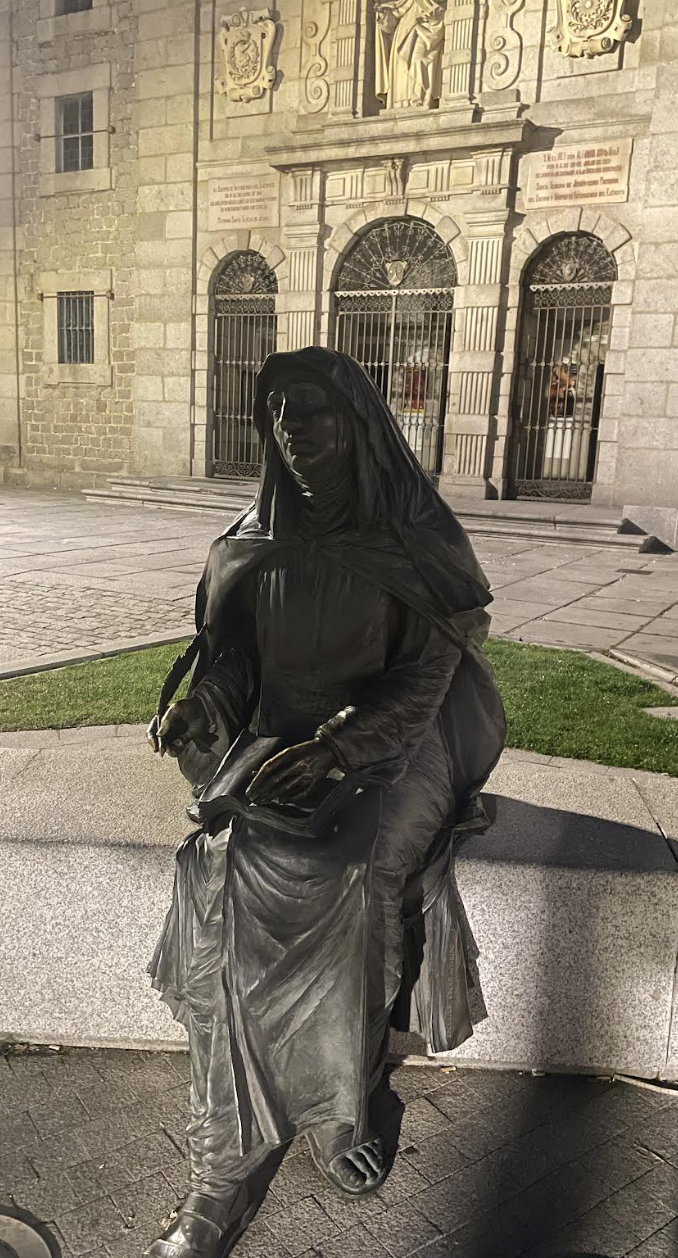
There was nobody to be seen except for a solitary seated figure. I wandered closer and realised that I was looking at Saint Teresa herself. I ought to add a disclaimer here, just in case you happen to be a stickler for petty details: it was not the saint in person (she died in the sixteenth century, after all) but a metal statue made in her honour.
Teresa is such a venerated figure in Ávila that her image and name seem to appear everywhere. Religious folk come from far and wide on pilgrimage, both to Ávila, where she was born and spent much of her life, and to Alba de Tormes, some 100km away, where she died in a Carmelite convent. Unexpectedly, in the Plaza de la Santa, in the quiet before dawn, I had come across her sitting by herself, quietly waiting.
By all accounts Saint Teresa, born Teresa de Cepeda y Ahumada, was a real A-list saint. She was not only a reformer of the Carmelite order but also the founder of many convents throughout Spain. And leaving all that religious stuff to one side, she is also lauded today as a feminist and as a leading prose writer whose work is studied in Spanish literature classes.
On reflection, had I met and spoken to the real woman, I imagine I would have been far more impressed by her than she would have been by me. She seems to have led a very spartan, simple life (going “barefoot”, in sandals strictly speaking, fasting, keeping silence and all that) and would probably not have been impressed that I had downed a ludicrous number of glasses of red wine the previous night and stuffed my face with Ávila’s famous chuletón, a slab of steak so big it would have met the protein requirements of a convent of Carmelite nuns for at least a year.
Had we really got chatting, she might have asked why I hadn’t been in church for so long, despite being a Catholic. I would have had to discuss the tensions between religion and the scientific ideas that came along after her time.
It would have been a long conversation, probably too long to finish before the sky lightened and the plaza began to fill with strangers.
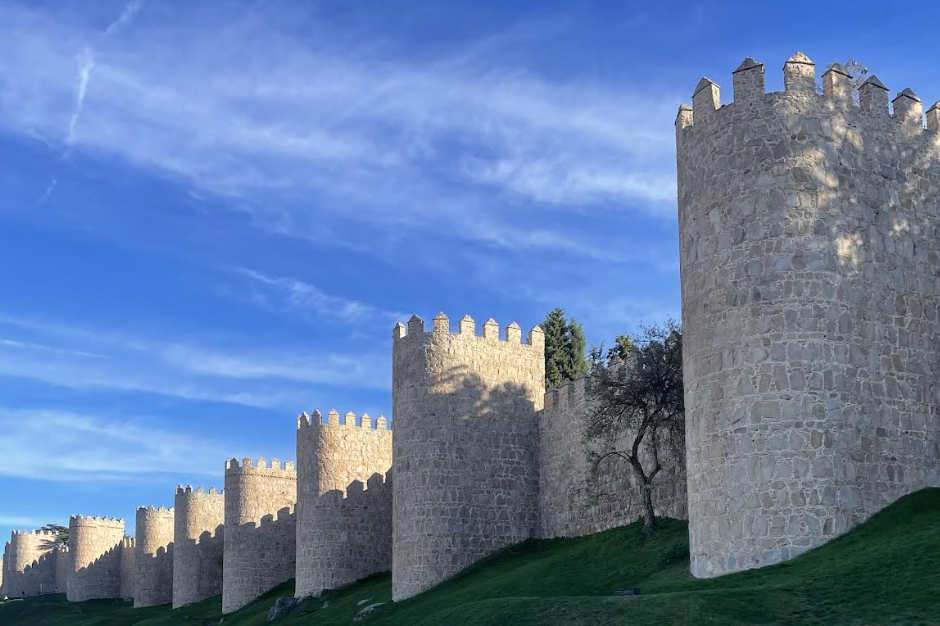



Ávila is one of the only three Spanish towns completely embraced by a medieval wall. The other two are neighboring Segovia and Lugo (Galicia), although the latter’s wall originated in the late Roman Empire. All of them deserve a visit, have delicious signature plates and good trout rivers in the nearby!
Thank you for that! We must add Segovia and Lugo to the list! I would love to return to Ávila. We are spoiled living here.
My daughter is a Teresa, and also a Saint in my eyes!
I bet she is a saint!