
If you have ever been fortunate enough to visit New Zealand and fish for the trout for which the country has become famous, you will know all about sandflies. Continue reading
Category: Natural history
It looks like the weatherman was right. Outside the heavens have opened. The French have an expression for weather like this:
“Il pleut comme une vache qui pisse”
It was because this weather was due that I was particularly keen to get to the river on Saturday before the rains bring the water up and colour the river. Continue reading
On Saturday I turned 50. This is something I am struggling to get my head around. It was a day spent travelling but I was looking closely at how the day progressed to see if the omens were looking good as I took my first tentative steps into my sixth decade. Unfortunately, things didn´t seem to be going particularly well.
First, the elastic on my underpants snapped and I was trying to get myself and the kids trough airport security at Gatwick. This meant that while fooling around with passports and boarding cards my underwear was rapidly making its way down my trouser legs.
And things didn´t get better. When I tried to look at the computer screen at home I struggled to focus and then discovered one of the lenses had fallen out of my glasses and disappeared somewhere in Malaga.
I was struggling to put a positive spin on life when my brother Sean sent me some interesting news from Ireland. He had chanced on an unusual raptor while out walking with his dog. It was huge. The great bird landed in a tree about 40 yards away and Sean managed to identify it as a juvenile golden eagle.
Golden eagles are being reintroduced to Ireland after an absence of almost one hundred years. Sean reckons that the bird he saw flew from Killarney which is some 50 miles from where he saw it. “No bother to an eagle” he says.
Golden eagles are one of the most widespread of the large eagles and they are relatively abundant here in Spain but, because they need large territories and don´t like built up areas, they are never common. A sighting is always exciting. Norman Smith, a fellow fisherman who lives nearby, also had a close encounter with a golden eagle recently.
I think that, in contemplating the omens for the future, I will ignore wardrobe malfunctions and temporary visual difficulties and think, instead, of Sean´s positive suggestion that the sight an eagle on your birthday is “a sign from nature of great things to come”.
The lovely photograph below of a male golden eagle was taken by Martin Eager of Runic.com

I was first taught the “birds and bees” lesson about human reproduction in my last year of primary school. Before that I had given the matter no thought at all, unlike the kids of today who seem to know enough to write a PhD thesis on human sexuality by the time they are 10.
I can remember the lesson very clearly. While we were out on the playground playing our customary game of football with a tennis ball, Miss Howe had been busy drawing enormous diagrams of human genitalia on the blackboard and these diagrams became, naturally, the focus of our attention as soon as we returned to our desks.
This was a kind of awkward situation and I was keen to see how the other kids were going to react. Would they giggle? Would they blush? Did they look as though they knew all this stuff already? Most of them gave little away but I noticed something odd about Jimmy Simmonds.
Jimmy was one of those kids with thick lenses on his glasses which distorted his eyes and made it look as though he viewed the world through the bottom of beer glasses. What was immediately obvious about Jimmy, and this image I will never be able to erase from my memory, was that his reaction to the huge chalk diagrams could not be read from his eyes because the insides of his spectacles had completely misted over. The structures of the human reproductive organs were hidden from him by a thin layer of fog.
It’s funny how things work out. I am now a teacher myself and, Like Miss Howe, I find myself explaining to a new generation where babies come from.
It is difficult to think about sex and sexual reproduction without our natural bias towards reproduction in humans. If kids are told that the next topic is sexual reproduction they will assume it is about human sexual reproduction and turn up to the next lesson on time, or even early, and foaming at the mouth. But sex is, biologically speaking, what makes the world go round and is overwhelmingly common in just about every species you might care to think of. Even flowers and trees contrive to reproduce sexually in the majority cases although they have no awareness that they are doing so.
Biologists have often been puzzled by how commonplace sexual reproduction has become. It is not necessarily the easiest or most reliable means of producing offspring. For one thing you need to locate a reproductive partner or organise, as flowers do, for your sex cells to be delivered to one. But the benefits in terms of genetic reshuffling during the formation of sex cells, and the new genetic variability resulting from combing the genes of two parents, seem to outweigh the costs involved.
I usually introduce the sexual reproduction topic by getting the kids to think of organisms which are not human, and among my favourite are the fish. And, among the favourite fish of fly fishermen everywhere, and at the top of the list for many, are the salmonids.
Salmonids, which include char, trout, salmon and grayling, can be taken as pretty representative of fish in general in terms of how they reproduce. Sperm cells can swim quite happily in water they are released there by the male fish and fertilise eggs, which are also released into the water by the female. This typically happens in fast flowing, cold, well-oxygenated water in the upper reaches of rivers and streams. This external form of fertilisation is typical of fish and frogs and other animals that reproduce in the water. Of course, problems arise for animals that live on dry land and it is the absence of a liquid medium through which sperm can travel that drove the evolution of internal methods of fertilisation of land lubbers like us. In humans the sperm need to be deposited inside the reproductive tract of the female which results, among other things, in the giggling of the kids sitting in the back of the class in Year 9.
Before returning to the salmonids, here is an interesting thing that happened at work a few years ago. One of my colleagues came into my class in an agitated state. She was, at the time, teaching the “Sexual Reproduction” topic to Year 7 and was having to fend off probing and embarrassing questions on the topic by one of the boys. There seemed to be nothing he was not prepared to ask. I could only sympathise. Fearless kids like this can make teaching this stuff tricky. It was only some time later that I got wind of the fact that the other, more timid boys, were paying the other kid to ask the questions on their behalf. They were egging each other on, each trying to come up with a question to make the teacher most uncomfortable.
The going rate for questions about sex? One euro a pop.
Where were we? Okay, I remember, back to the salmon and trout. Once the fertilised eggs are deposited and covered by stones they are pretty much on their own. Mum and Dad are not going to be around to take care of them and, invariably, a punishingly high level of mortality results in very few of the offspring surviving even their first year. To offset these huge losses, large numbers of eggs are deposited and this, again, is quite typical of fish.
It is probably fair to say that it is the reproduction of salmonids which is best known by people with no particular interest in fish. The image of a salmon navigating obstacle and dangers to return from their ocean feeding and growing to the rivers of their own birth is vividly etched in the popular imagination. We have all seen the waterfalls they leap and the grizzly bears trying to hunt the fish as they push their way endlessly upstream. It is the salmon, and particularly the half dozen or so species of Pacific salmon that swum through our television sets and into our living rooms. They provide a spectacle that is unrivalled in natural history.
But the price to be paid for sex by these salmon is death. The Atlantic salmon may survive the rigours of spawning, although most do not, but this is not true of their Pacific counterparts whose spent bodies, post-spawning, litter the watercourses like the petals of flowers that have served their purpose and remain scattered on the ground. The nutrients within those remains are locally recycled and the whole migration can be seen as a swimming conduit of nutrients from the cold ocean to the interior of a continent hundreds or thousands of miles distant.
Reproduction of brown trout is essentially similar although the migratory distances will be relatively short. Some sea-going trout will have returned from their coastal wanderings to spawn, like the river relatives from which they are genetically indistinguishable, they are very likely will spawn in the rivers in which they were born.
Most of this drama is unseen by the fishermen who might have spent hundreds of hours chasing after trout during the fishing season. I came across some beautiful photos taken by Miguel Aguilar which show trout spawning. If you would like to see them, you might like to follow this link:
http://issuu.com/flymagemagazine/docs/flymage_15_october_2012_eng/33?e=0
I got a present of a book by Bob Wyatt for Christmas. It is called “What trout Want”. Wyatt is a good writer and this is a fine book from which I learnt many things. It also threw light on a mystery: the giant trout of the back country rivers of New Zealand.
I have long been puzzled by these iconic fish. Their large size and the remote pristine landscape they inhabit probably draw thousands to New Zealand each year. The thing I found odd about these fish was that most of them seem to be males, often broad in the back and with the characteristic kype. Why is this? And how could such huge fish sustain their bulk in these headwaters?
The answer, according to Wyatt, is that these are fish which have remained in the reaches of the river close to their spawning grounds after the others have dropped back to the more hospitable reaches of the river further downstream, or into large lakes into which these rivers drain. The fish may indeed struggle to maintain their bulk here and many will, in due course, work their way downstream where the food supply is more likely to meet their demands. And there they may remain until the powerful reproductive urges drive them upstream to spawn again.
It is difficult for me to think about things like the back country trout and the powerful drive that push salmon to the spawning grounds following their ocean wanderings. It is enough to make my glasses steam up!
I found this lovely drawing of a male (top) and female brown trout (bottom) on a blog called The Weedbed Blog. It was made by a Canadian guy called Nick Lafferiere.

Yesterday, while I was fooling around on the river, my friend Harry was off enjoying the kind fishing adventures guys like me can only dream about. Like me, he landed a couple of fish, but his were absolute stunners. One was an Arapaima, one of the largest-growing freshwater fish in the world and the other was a Pacu, a deep-bodied fish, not unlike a piranha to which it is closely related. I have seen both of these before swimming around in various aquaria and know a little about them. Both come from South America and so, when I saw Harry´s photos yesterday evening, I assumed he was having some crazy adventure on the Amazon.
As it happened he was in Thailand fishing a water stocked with various kinds of large tropical fish. The other anglers fish more conventionally using bait but Harry is, in his heart, a fly fisherman and he took both of his fish in the fly.
Arapaima are fascinating things. They need to surface periodically to breathe air and can survive in places which are so depleted in oxygen that many other species fail to survive. They also have such tough scales that they are able to resist the attention of piranhas. What I was little prepared for, when I saw Harry´s photo was just how beautiful they are. They have a flattened head which appears almost reptilian, and large scales protecting an elongated body.
Harry said that the Arapaima hit the fly pretty much as soon as it hit the water and that it was dark before the great fish was finally released.
The Pacu are as strong as hell. The specimen pictured was estimated to weigh 9 or 10 kilos. Apparently they have extremely sharp teeth and will bite through anything that is not made out of steel. Harry hooked his fish with a nymph and it was not taken in enough to result in his line being bitten through. Apparently hooking these things is like getting you fly caught in the 10.23 from Paddington, and they will do their level best to snag you in some underwater obstacle if they have not already bitten through your line. I had always thought of them like big docile herbivores, like swimming sheep, but I obviously underestimated them.
Harry is on his way to New Zealand and was kind enough to allow me to report on his adventures. So hopefully we will have more stories to report soon.
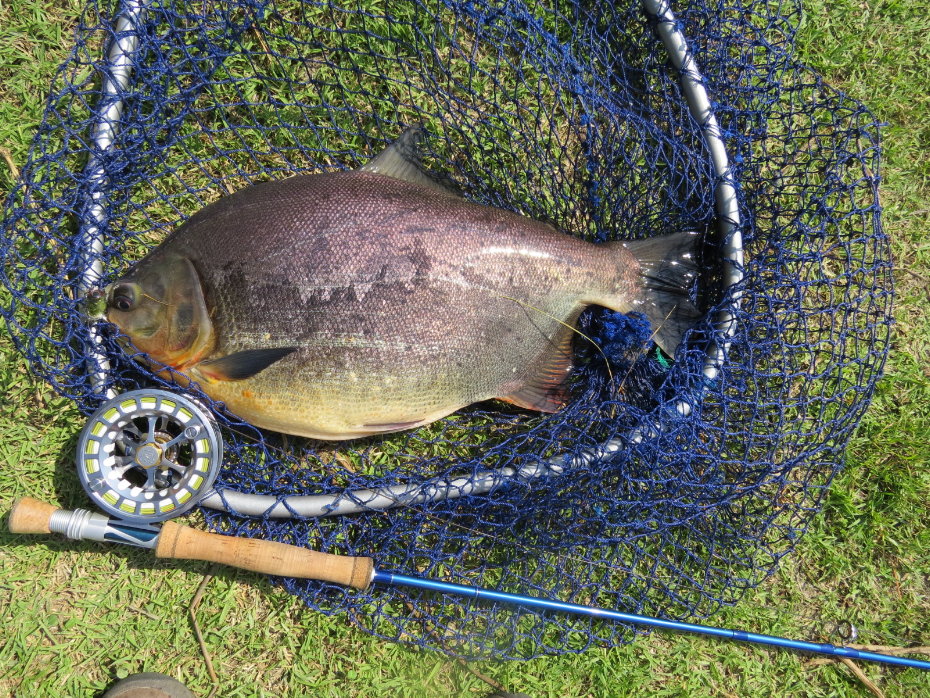
Pacu
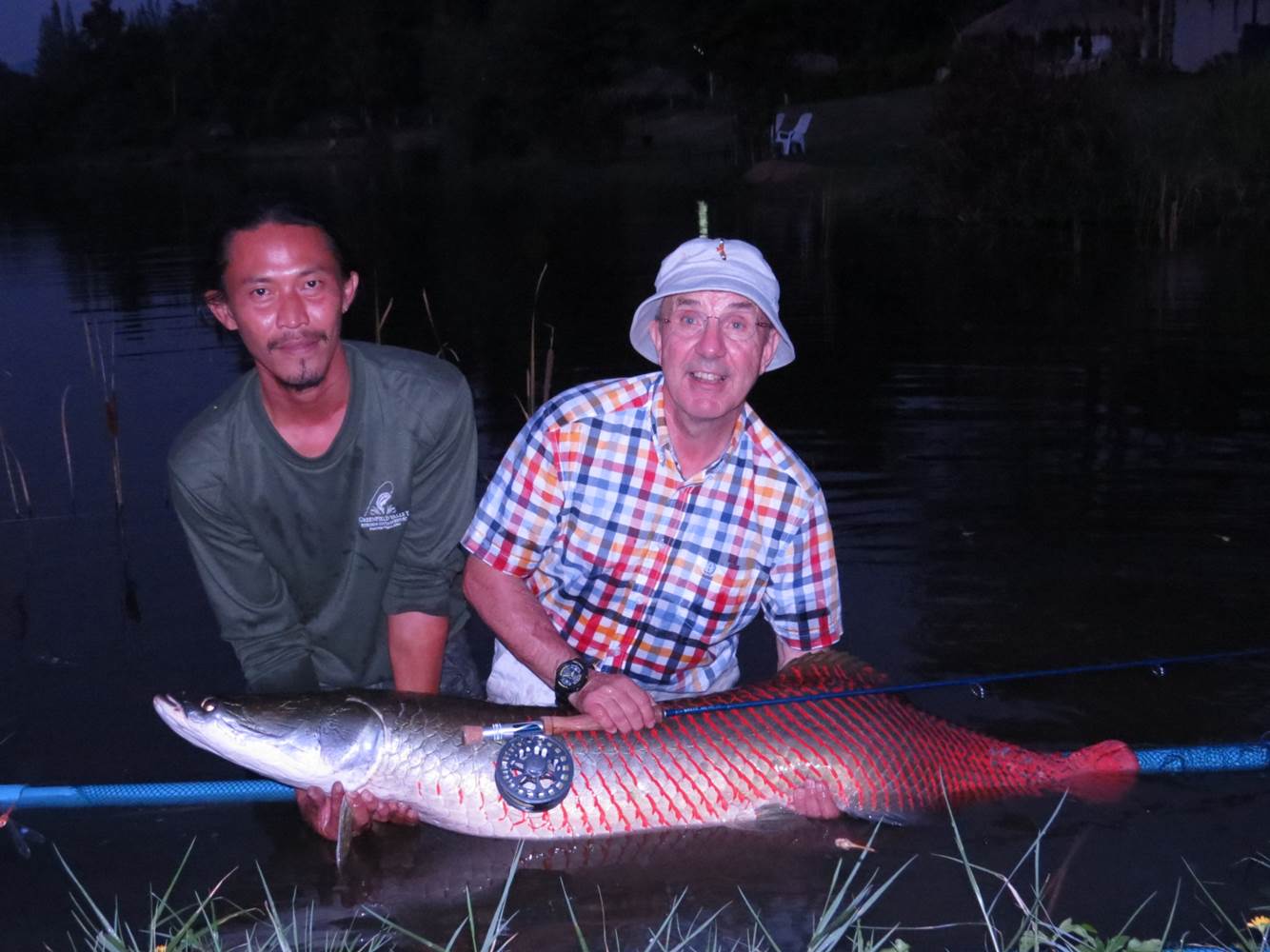
Harry with his beautiful Arapaima, estimated at 25 kilos.
This supposed to a blog primarily about fly fishing fly but, as you may have noticed, I tend to get side tracked from time to time. And now, in a discussion of animal turds, it looks like this might be happening again. But funnily enough, the two subjects are connected and the link between them is not as tenuous as you might imagine.
Scientists who are interested in studying mammals spend a lot of their time looking at their droppings. It stands to reason. Many mammals are small, secretive and nocturnal, and it is difficult to observe their behaviour directly. But their droppings, if we can find them, speak volumes about what they have been getting up to.
I once took a small group of students to the National Park at Doňana which is one of the last refuges of the critically endangered Iberian Lynx, one of the rarest cats in the world. During a night walk our guides stumbled across an animal dropping which they thought might have come from a lynx. You should have seen how excited they were! It was as though they had stumbled across a winning lottery ticket. The Doňana guides carefully bagged the dropping for further analysis. The lynx turd could yield fragments of bone and fur which might give some insight as to the behaviour of a cat, which is very rarely seen.
The droppings of grazers may not tell us so much but they do testify to the efficiency of digestive systems which are quite specialised. They need to be because grass is quite low in energy and is very difficult to digest. The important task of breaking down the cell walls of the plant cells is done by microorganisms, like bacteria, because no mammals make the enzyme cellulase that carries out this nifty trick. As a result of this, grazers often have specialised compartments in their alimentary canals to house these microorganisms. Most famous is the cow´s “four stomachs” only one of which corresponds to the “true” stomach. The biggest compartment, the rumen, is a huge fermenting tank from which material is periodically regurgitated to be chewed again. This is what cows are getting up to when they are chewing the cud. This way of getting the most out of diet of grass is shared by other familiar ruminants like sheep and goats and deer.
Rabbits are about the smallest mammals that can survive on an exclusive diet of grass. They are obviously too small to house a bunch of stomachs and so they have solved the problems of digesting by the simple expedient of passing the food through the entire digestive system not once, but twice. After the food has gone through the digestive system the first time it is ingested again, in the form of a soft pellet, and passes through the digestive system for a second time. Rabbits, like cows, depend on microorganisms to break down the plant cell walls, but they house them in a long blind-ending compartment called the caecum.
We have a pony grazing outside the house at the moment. The builder, Juan, asked if it could graze on our bit of land and we were happy to have it. I have no idea how long the pony that we have christened “Tony” is going to be with us but, while it is here, it is happily converting the wild growing plants into nice compact manure. Tony, like horses and donkeys, is a hind gut digester and houses billions of bacteria in the caecum and large intestine.
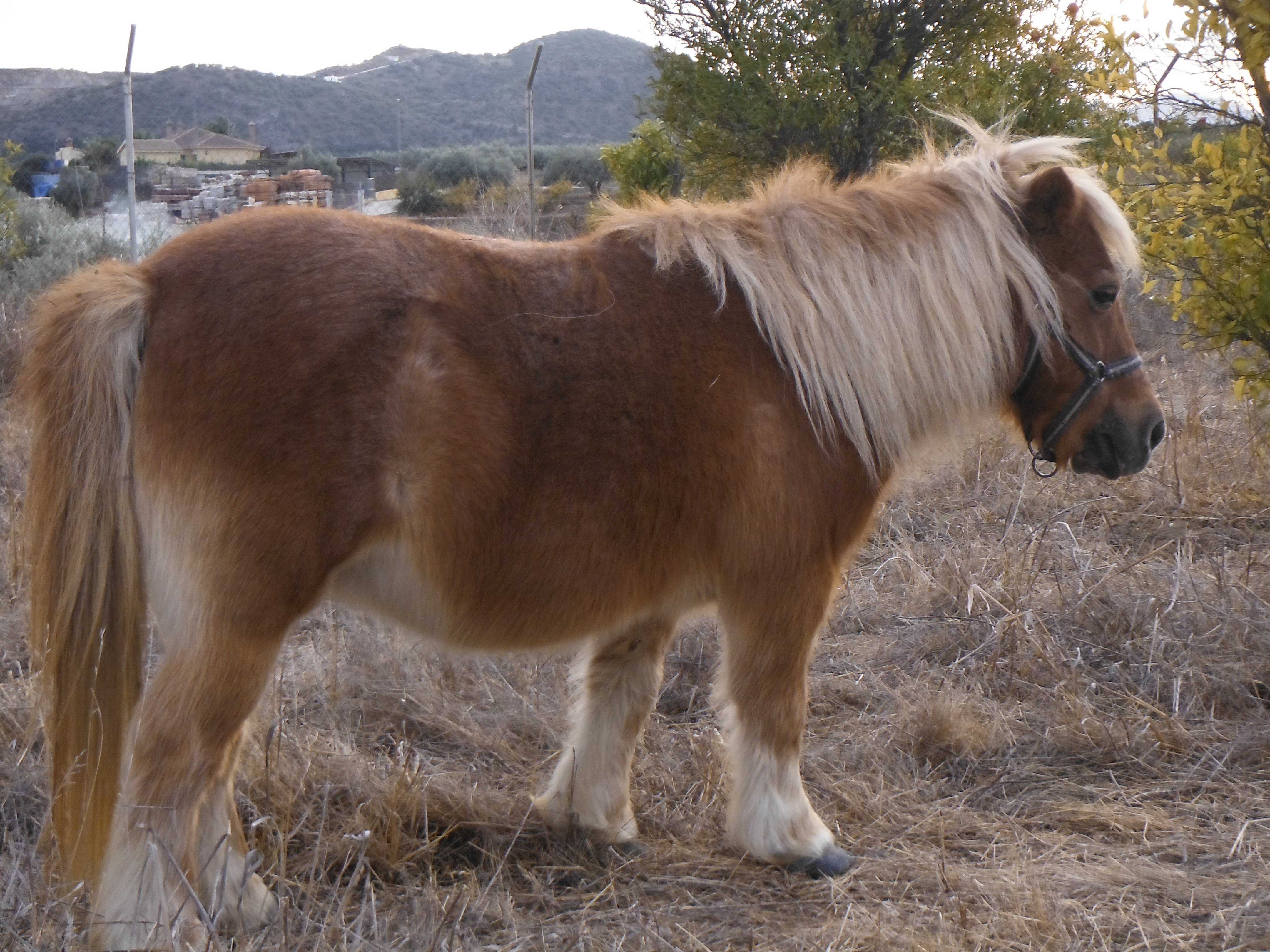
Tony the pony.
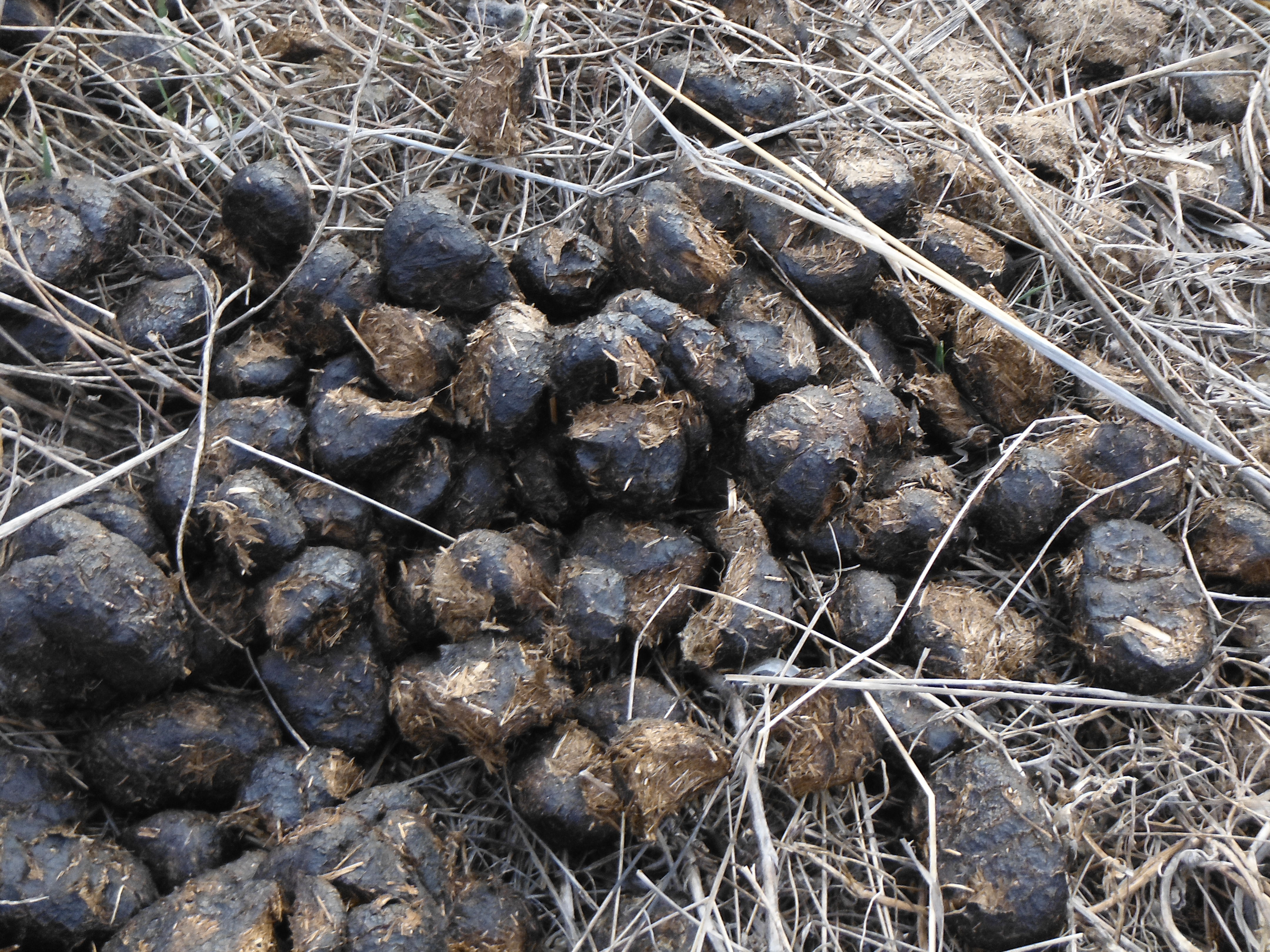
Tony the pony´s legacy

Pippa with her rabbit, Molly. Maybe bunnies are not as cute as we thought!
Right, enough about turds! What has any of this go to do with fly fishing?
Turds, and particularly cow turds, can be good or bad for fishing. A fresh cow pat is larder for a variety of insects and other invertebrates like dung flies. A fresh cow pat, with the consistency of porridge, may not look too appetising to us but for little bugs it´s like getting a Christmas hamper! For the fly fisherman this can be good news too. We can tie up an imitation of a dung fly and see if there is a trout nearby who wants to play ball.
A Dung Fly

But cow shit is, on the whole, bad news. If it seeps into streams and makes its way into rivers or lakes it artificially enriches the water and acts, as it does on land, as a fertiliser. This can lead to through the proliferation of algae to a process called eutrophication. It is this process which has had very damaging effects on places like Lough Sheelin although I believe it was the wastes from pigs rather than cows that were to blame.
I was prompted to write about this because of a very interesting letter published in this month´s Fly Fishing and Fly Tying Monthly and sent in by David Pilkington. It would seem that pour on insecticide chemicals which are given to farm and domestic animals can affect the droppings also which can become toxic to invertebrates. Not only are the insects which would normally breakdown wastes affected but, as a natural consequence, so too are the birds which feed on them. And the cow pats, no longer broken down by the usual hordes of invertebrates, remain wet and slimy and more likely, perhaps, to find their way into a water course where it causes a whole bunch of problems.
It is a worrying problem and a reminder, if we need one, of how we can pay a price which is often indirect and far from obvious, for intervening in the natural order of things even though we might have the best intentions.
A bad fishing day, in most of our eyes, would normally consist of hanging your best flies in tree branches, catching nothing, getting lost, falling in or all of these things happening. But it seems that a bad day could, at least in theory, turn out to be far, far worse.
Here in Andalucia, we get the odd report of escaped crocodiles and the thought of being eaten alive is enough to satisfymost people´s definition of what constitutes a bad day.
Last year a nile crocodile was seen sunning itself on the side of a little lake near Mijas. It was a place I had investigated a few years as a prospective fishing site, but its depth and difficult access made it an unsuitable venue for fly fishing. The crocodile, in the end, was found dead and an autopsy revealed the cause of death was an obstruction in its alimentary canal due to something it had eaten. This crocodile was over two metres long.
A few years back at least one crocodile was caught by the civil guards on a stretch of the Guadlahorce near to Cártama. It was quite close to the Crocodile Park which has since moved to Torremolinos. Naturally, everyone thought the crocodiles had escaped from the Park but the Crocodile Park people I spoke to tell me that it is likely to have been released into the wild by unscrupulous bastards who keep these things as pets. It´s one thing getting bored with your gold fish and flushing it down the loo but cute little pet crocodiles that somebody sets free have the potential to become big horrible mean crocodiles that might take a fancy to a guy like me.
This is almost certainly the way the Mijas croc turned up. Apparently, there are plenty of crocodiles kept by individuals here on the coast and the climate is ideal for these things. A few years ago new legislation tightened up on the keeping of crocodiles by individuals and, no doubt, a few animals may have been released on the quiet. The suspicions of the Crocodile Park bloke I spoke to was that the Mijas crocodile was released by a nearby Russian who was big into the drugs trade and exotic pets.
Now don´t get me wrong. I think that crocodiles are great. Nobody loves them more than I do. I just took a bunch of kids to the crocodile park last Thursday and was greatly impressed by those great lumbering creatures. There is one old nile crocodile there called Paco who is 90 years old and is the father of most of the crocodiles in the park. He is absolutely huge. He impresses his four 25 year old girlfriends by lying at the bottom of a pool and bubbling air out of his eye sockets. My wife does not know this, but I have similar plans for my old age. When I am 90 I want to have at least four 25 year old girlfriends. I can´t do the eye socket thing yet but I´m working on it.
The appearance of crocodiles where they are not expected is a little worrisome. There is, at least in theory, a small chance that I may end my fishing career inside the belly of a great reptile. I don´t particularly want to end it all this way although I guess it beats cardiovascular disease or cancer hands down. No dribbling in an old folks home for me! No incontinence pads, no endless repetitions of fishing stories, no forgetting everything – just a glorious death roll, a muddy thrashing in the shallow water and finally, from the bowels of the Guadalhorce as the ripples subside, a happy, postprandial burp.

A nile crocodile swimming in the crocodile park, Torremolinos.
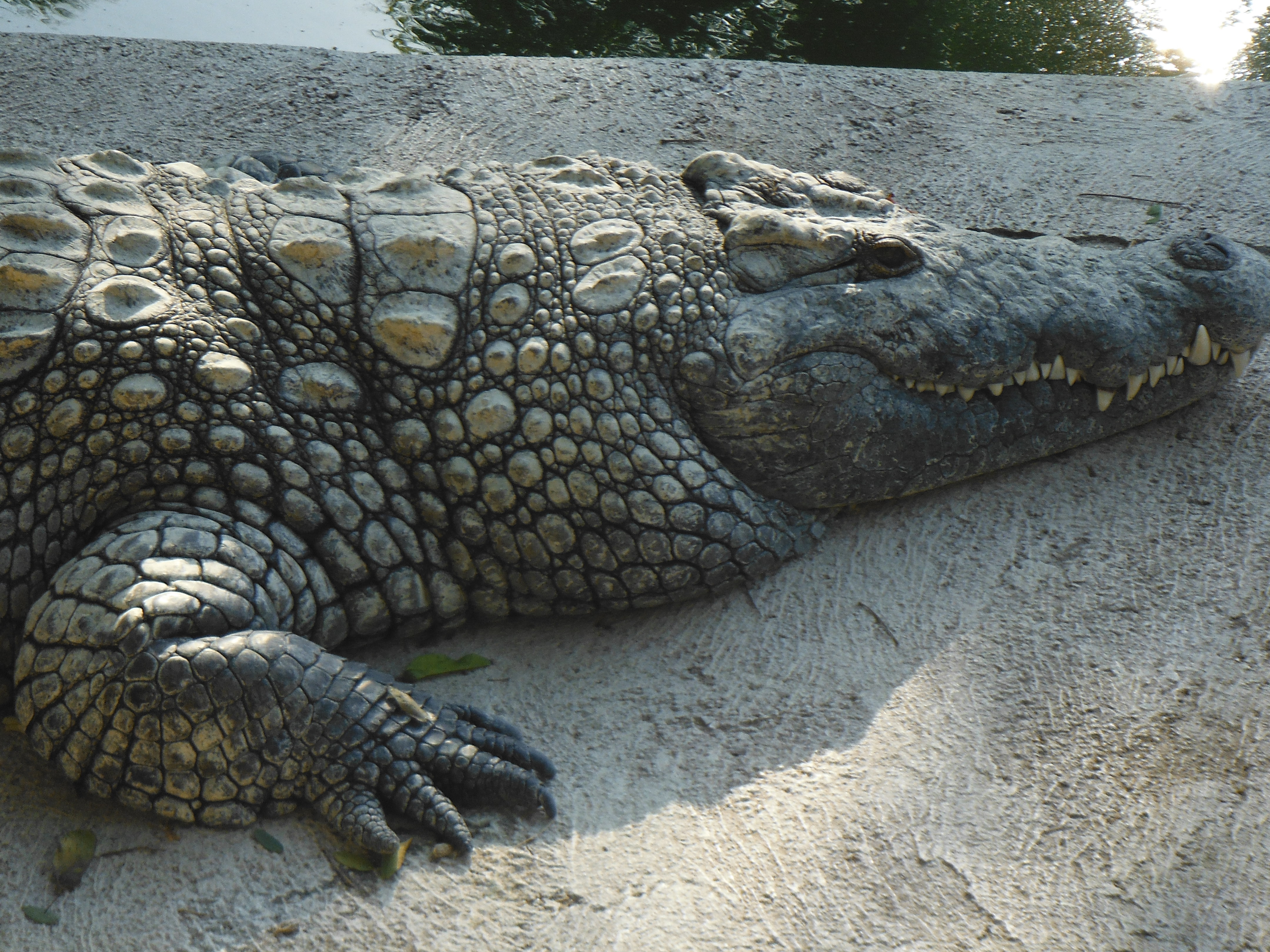
A crocodile not swimming at Torremolinos Crocodile Park!
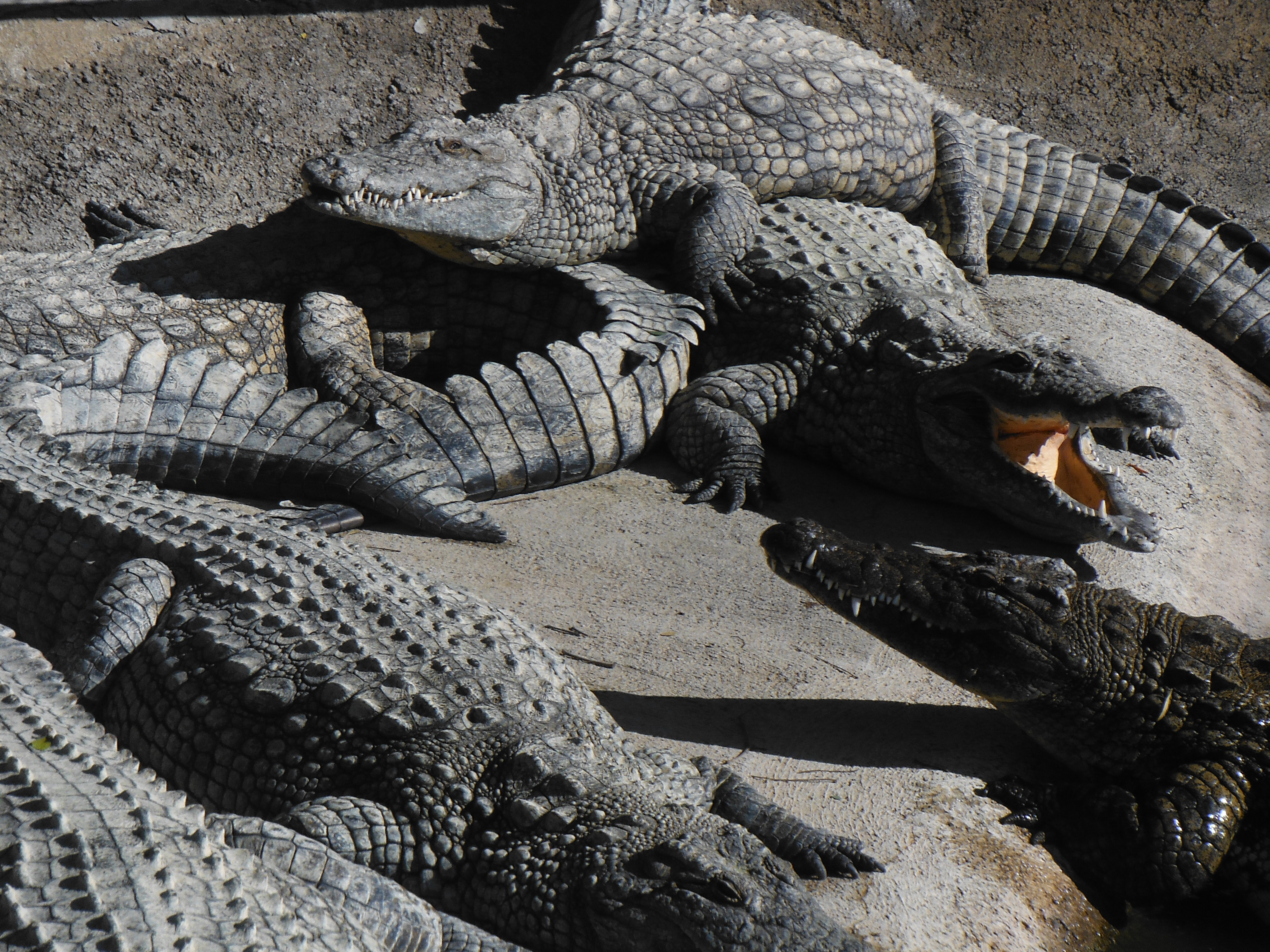
Heaps of crocodiles
Last night on the river I didn´t see any crocodiles, thankfully, but I saw plenty of turtles. These are often heard rather than seen as they tip themselves into the river from rocks and branches if you happen to come too close and interfere with their sun bathing. But last night they gave themselves away when their dome shells broke the surface of the shallow water. I came across four or five breaking the surface in this way and another one 20 metres or so from the river. It was lying on the ground with all its protuberances withdrawn into the shell. I imagine that it had left the river recently because it was still quite wet. For the hell of it I carried it back to the river to let it go in the hope it would start walking off and give me a chance to photograph it in action. But it had no interest in posing for photos and remained tucked in until I lost interest and wandered upstream where another turtle was more cooperative.
These turtles are native to the river and there are two very closely related sub-species. They are threatened by the invasive red necked turtle from Florida which everyone keeps as pets and which escape or end up being released into the wild, often by well-meaning people. In some areas, like Doňana national park, the red necked turtles are actively eradicated or removed.
I hope that the Florida turtle keep away from my local stretch of the river. And the crocodiles too!

The popular Florida red neck turtle. This invasive species is displacing native turtles.

A wild turtle seen swimming in the river last night.

 fishydreams