
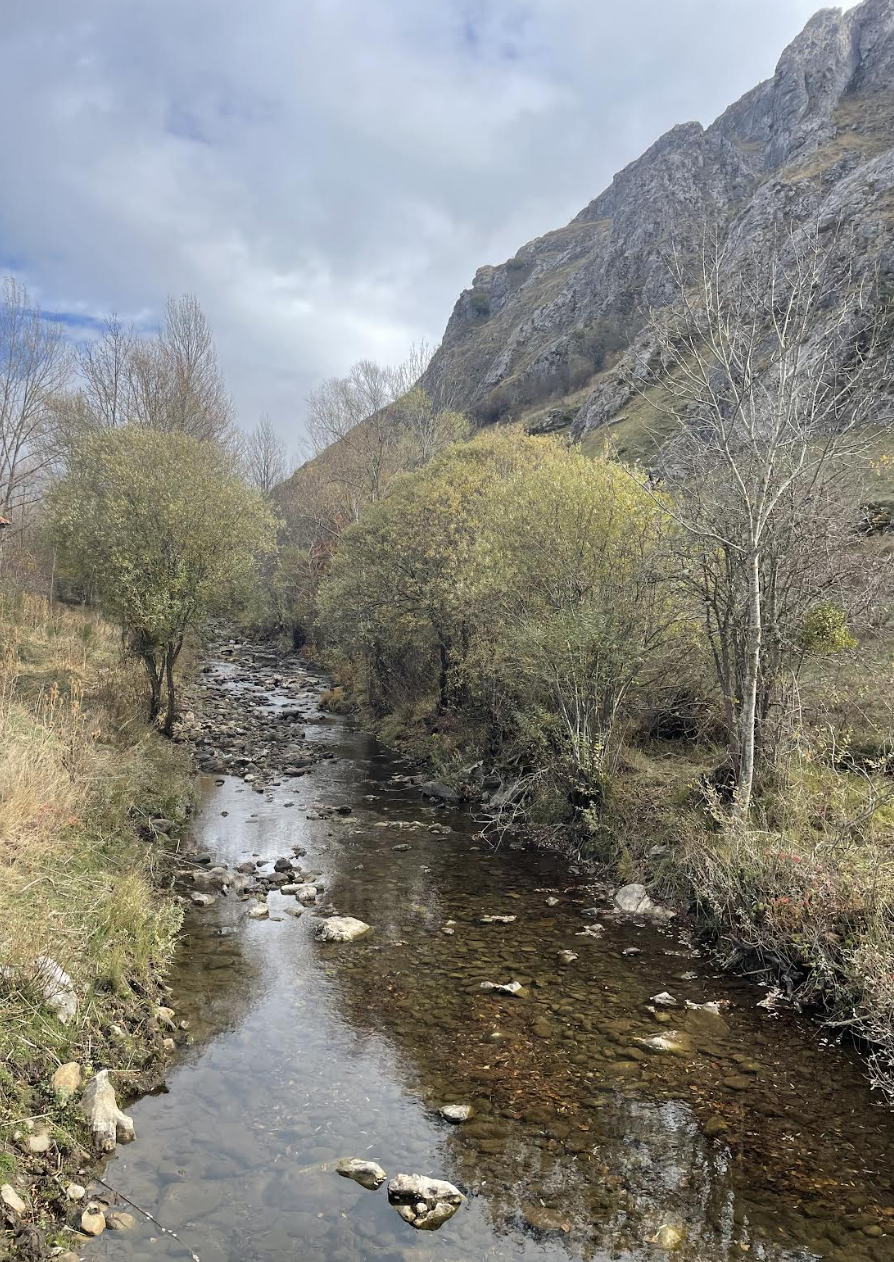
Paul Reddish and I took a trip along the Pisuerga River yesterday, meeting the river in Aguilar de Campoo and following it upstream towards its source in the Cantabrian Mountains. The road can only take you so far — we pretty much ran out of tarmac in the little village of Santa María de Redondo, home to dogs that sleep in the street and begrudgingly allow you to drive on. There’s an ample car park for those who want to hike further, but it was a little late in the day for us to do that. That hike follows the course of the river initially before separating, but it eventually leads to the river’s source, said to be a spring called Fuente Cobre.
Like the Ebro, whose source at Fontibre we had visited the previous day, the source of the Pisuerga is disputed; some say it rises from a glacier at higher altitude. I rather like that idea, so I’m going along with it!
Even though the source of the Pisuerga is barely 80 km from the northern coast of Spain and the Cantabrian Sea, high peaks block any potential flow in that direction, steering it southward for 270 km before it enters the Duero (the Pisuerga is its second-largest tributary). The combined waters then flow a further 900 km westward through the Portuguese borderlands before meeting the Atlantic in the city of Porto.
In this northernmost part of Castilla y León, where the young river runs ankle-deep and you can cross it by jumping from rock to rock, it’s hard to imagine that it will one day grow so dramatically that its waters will float ocean-going ships moored along the wharves of a distant city in another country.
The source of the river, whether the spring or the glacier, lies in the heart of a wilderness that provides a home to bears and wolves. The bears here are known as Cantabrian brown bears, a distinct population of the more widespread Eurasian brown bear. There are estimated to be around three hundred individuals, and their numbers seem to be stable or even on the rise. For someone like me, it’s heartening to know that they continue to thrive in their remote outpost — though, as you’d expect, not everyone is a fan of bears. Livestock farmers may see them differently, as do, curiously enough, beekeepers. Bears, as Paddington is only too happy to remind us, are very, very fond of honey!


 fishydreams