
There is a lough halfway up a mountain that we simply call the “Mountain Lough”. The word “lough” is overstating things a little because it is nothing like the expansive bodies of water you might first imagine when you think of the loughs of the west of Ireland. I guess we are even overstating things when we say it is on the flank of a “mountain” because it would not stand out in the general topography of this landscape as anything particularly worthy of note. It is high enough, though, to sap the strength from your legs as you climb the boggy slope and your boots sink into the sphagnum moss as though you were making your way over a giant sloping sponge. The climb will certainly take enough of your strength to make you stop once or twice to take in some air and this gives you a chance to turn your back to the mountain and, if the skies permit, to look out over vast tracts of green fields and the reflected silver of other small loughs and, distantly, the river Shannon.
This is “our” Mountain Lough. There are many others. It has a name in Irish which I can never remember. Occasionally I ask my brother what it is and he tells me. And then I forget again. He tells me also of the legend and history of this place which is also hidden in its name and this is also gone from me. I should probably do better than this. Like the imposing rocks and fissures, mountains and streams here, this lough has its place in local history and in myth. But even if this is not known to us, we can feel that this water dispenses magic on every visit.
If you fish here you will fish alone, or more likely, with the one or two who trudged up the slope alongside you. Nobody else is likely to be there. I have fished here with my brother Sean, our friend Mark, and my son Leo. My daughter Pippa made the trip too but fishing was not her thing. She was small then and found that more fun was to be had chasing the tiny frogs that were present everywhere.
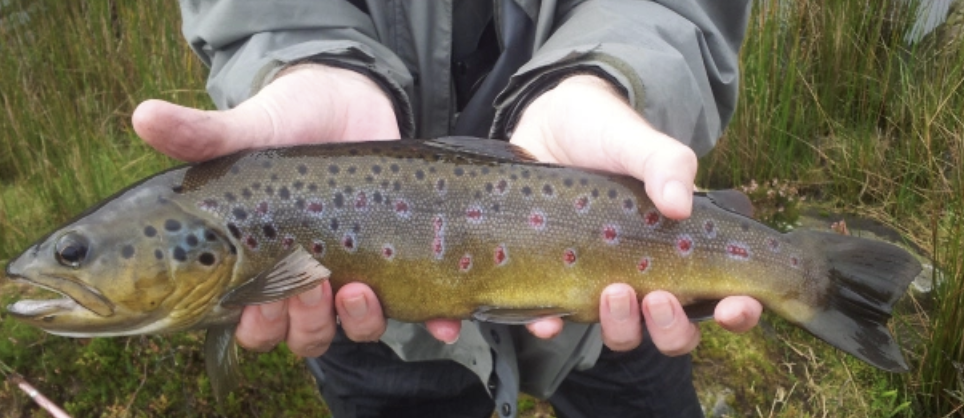
Leo caught his first trout here on a little deer hair sedge. That trout was perhaps a quarter of a pound or maybe a little more but it was beautiful, as are all the trout that come from here. The water is peaty and the fish are very dark, black almost when seen from above. They have a couple of rows of red spots, each surrounded by a pale halo, their black eyes portals into a distant, unknowable reality.
That fish of Leo´s was like most of the free rising mountain trout here. They are uniformly dark and their spotting, while unique as a fingerprint to each fish, never deviates enough from the norm to suggest that these fish are anything other than a closely related and isolated population. There is a small stream that runs into the lough. Their lives will have started there.
One time Mark caught a trout that was a whole lot bigger than any others we had taken. Most of the fish are about half a pound. Mark´s was, perhaps, two pounds or even maybe a little more. This fish surprised us because we did not think the lough was productive enough to support fish of this size. A fish like this will not raise eyebrows on most trout Irish loughs. A Sheelin fisherman might even be disappointed by it. But here, on this small isolated water often mist-hidden on a rainy mountainside, it was a leviathan. It is good to know that, even in the land of Lilliput, there are giants.
Our thinking is that this big trout was probably largely piscivorous, taking the smaller brown trout that, to the best of our knowledge, are the only species in residence here. Perhaps it might have occasionally dined also on the little frogs that Pippa captured in the margins.
I can visualise Mark´s trout with little effort, having used a photograph of this fish as a “type specimen” of the Mountain Lough trout for the purposes of watercolour painting. It is not quite typical. In addition to its size, its colouration seems a tad lighter than its smaller cousins. Like all trout it´s colours are deceptive. The conspicuous spots along its flank are given their red colour by the bright light when the fish is held out of the water. It is dark as I write this and the fish will have little light to reflect. Even during the daylight, red light has a weak ability to penetrate water at depth and in the peaty water close to the bottom the red colour is likely to be muted at best but probably absent. Those spots will be black. In daylight its colours will come to light as it rises to the surface, perhaps to take a drowned terrestrial insect. I have painted Mark´s fish several times. Each effort comes a little closer to capturing the real beauty of this fish but I know I will never get close enough.
That is just not possible.
Published by Fly Fishing and Fly Tying Monthly, February 2023

 fishydreams