
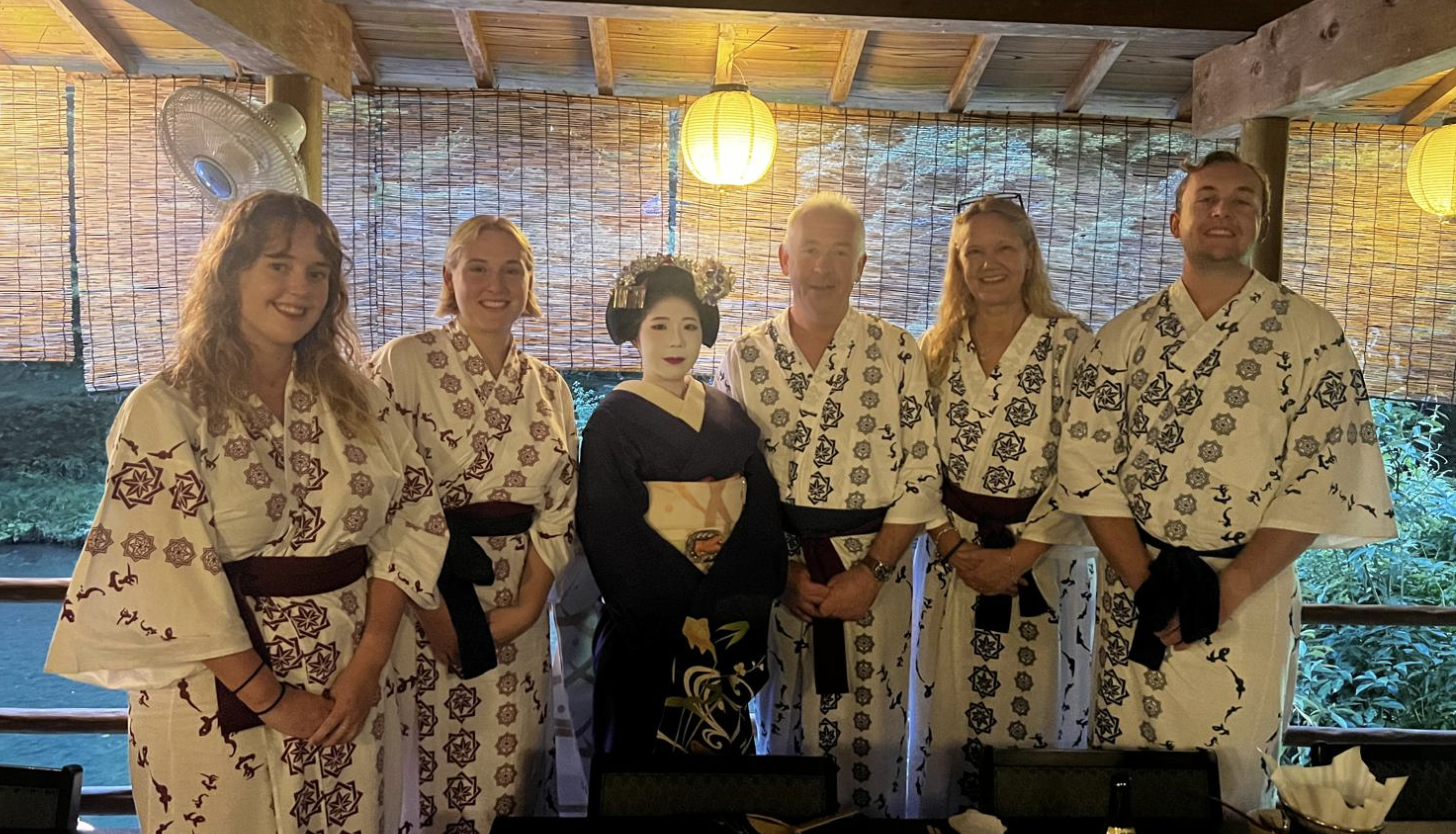
In our last night in Japan we had a chance to meet and speak briefly to a Maiko, a young lady undergoing training to become a Geisha (this training takes five years). She was moving from table to table in the restaurant where we were having dinner and she spoke briefly to the diners. She started with the table furthest from us and approached us slowly, table by table.
I think it was Pippa who pointed out that the protocol in addressing the Maiko, when she came to us, was to have a question ready for her and so, in the moments before she joined us we discussed what we might ask. This was back in July when all eyes were turning towards developments in American politics and so, tongue in cheek, I suggested that we ask her whether she thought Joe Biden should step out of the race (within days he was to do so). Predictably, I was berated for being an idiot while talk turned to finding a question that would be more appropriate.
When the Maiko finally made it to our table we asked her simply for her name and where she came from. I´m afraid the answer to the first question, about her name, went in one ear and out the other. With respect to the second though, I recall her saying that she came, not from the nearby city of Kyoto (which is a Japanese epicentre for all things Geisha), but rather from Hokkaido which is the second largest and most northerly Island of Japan. I had come across Hokkaido it as I looked into the possibility of sneaking off fishing and it seems to be a fascinating and wild place with a wide variety of salmonids to target including Japanese char, cherry salmon, taimen, rainbow and brown trout (both introduced) and dolly varden.
Sensitive to the social etiquette, I fought the back temptation to ask the beautiful young lady if she had every had ever taken a stab at the traditional tenkara fishing. It is a hard thing to picture. There is probably nothing so distantly removed from the average fisherman in terms of poise and elegance and beauty than a Maiko or a Geisha! Let´s face it. We don´t do grace and glamour!
Anyway, there were better questions to ask, including one we overheard from a neighbouring table. “How much does your costume weigh?”. The answer to this one, I subsequently learned, was some was some 30 to 40 pounds for the full Maiko ensemble.
After our brief dialogue, the Maiko very graciously offered to pose with us for a photograph and this picture,and others from that evening, are among the most valued momentos we have of our adventures in Japan.
Later in the same evening we were joined by a more senior Geisha and were treated to an exquisite dance. We had seen nothing like this before. Traditional Japanese dance is very different from western dance with movements that are very slow, deliberate and graceful.
When we met the Geisha and the Maiko I had only a vague notion of their role in Japanese life and in their history and have since made some efforts to put this to rights. Much of what I learned came from the memoirs of Mineko Iwasaki, a famous Geisha from Gion in Kyoto where we had walked ourselves a couple of days beforehand. In the Gion district Geisha continue to go about their business but there are signs about asking westerners and other visitors to refrain from asking for selfies and all that stuff. Fair enough!
Geisha represent art in living form and are experts in the traditional arts of Japan. Their name says it all with “gei” meaning art and “sha” meaning person. They are trained in the art of conversation, in the performance of elaborate tea ceremonies, art, calligraphy, acting, flower arranging, music and dance. The acquisition of such skills take many years and training is ongoing throughout their careers. Successful Geisha like Mineko can be celebrities in their own right and earn considerable wealth and fame.
As far as I understand things, the Geisha and Maiko will entertain guests and, in a party, it is usually the case that each will accompany a single guest. Such events are called “ozashiki”, and the same word describes the venue as well as the social event itself. In addition to performing music or singing the Geisha and Maiko will engage in conversation and may well have had to prepare in advance by learning something of the work and background of the guests who might include dignitaries, politicians, business people and even royalty.
Mineko, in her memoirs, suggested that she was not particularly impressed by the late Queen Elizabeth who would not touch any of the food prepared for her and who then seemed to get annoyed when her husband, the Duke of Edinburgh, was having too much fun talking to her! In her heyday Mineko also entertained President Kennedy and Henry Kissinger, amongst others.
Forgive me for lowering the tone here, but I had been curious about whether a Geisha or Maiko might become more intimately acquainted with their guests. After all they are beautiful young women and their guests, after a glass or two of saki maybe, might try it on. They are only human after all! The truth is that, although relations can and do develop between these women and guests, this is very exceptional and that if some guy is getting a little hot under the collar he should go elsewhere!
Interestingly, this question of where the line is drawn in such matters goes right back to the whole concept of Geisha and of how they differ from courtesans. Historically oiran (courtesans) and Geisha were intertwined and confusion still arises about the distinction (it doesn´t help that the American servicemen labelled the women they sought out for company as “Geisha girls”)
Back in the 1700s, as I understand it, there was a split between those women entertainers who services were purely artistic and those whose services might also extend to satisfying the more primitive urges of their clientele. Interestingly, the obi, which is a broad sash tied around the waist is tied differently in each case. The courtesan bow is positioned in the front where it is accessible whereas the obi of the Geisha is tied at the back. This is charmingly subtle and graceful way of letting their clients know that they should keep their mitts to themselves!
Japan is an amazing place and, as western visitors, I feel as if we have barely scratched the surface. The experience of meeting these charming young women, albeit briefly, was wonderful, but I was acutely aware of how little I knew about them or of the art and customs that they embody. Having dug a little deeper now I feel that I am, belatedly, just beginning to become acquainted with the Maiko and the Geisha and just beginning also to become aware of just how many questions we could ask them.

 fishydreams