
When we witnessed the cormorant fishing on the Uji river we were told that the fish that the cormorants catch are sweetfish or Ayu. I knew nothing of these fish and, in learning more about them, I found out about an ingenious way that Japanese fishermen catch them.
Ayu are no monsters and even the biggest would be an easy meal for any cormorant. Despite this, they are highly prized as a culinary fish, and their distinctive taste gives them the name sweetfish. The only ayu I ate myself was served up as a course in a meal, appropriately enough in a riverside restaurant. It was about the size of a large sardine. This fish was prepared by grilling on a skewer over an open flame in much the same manner as sardines are cooked as in Malaga in the form of “espeto de sardinas”.

This is how sardines are cooked in the chiringuitos of Málaga
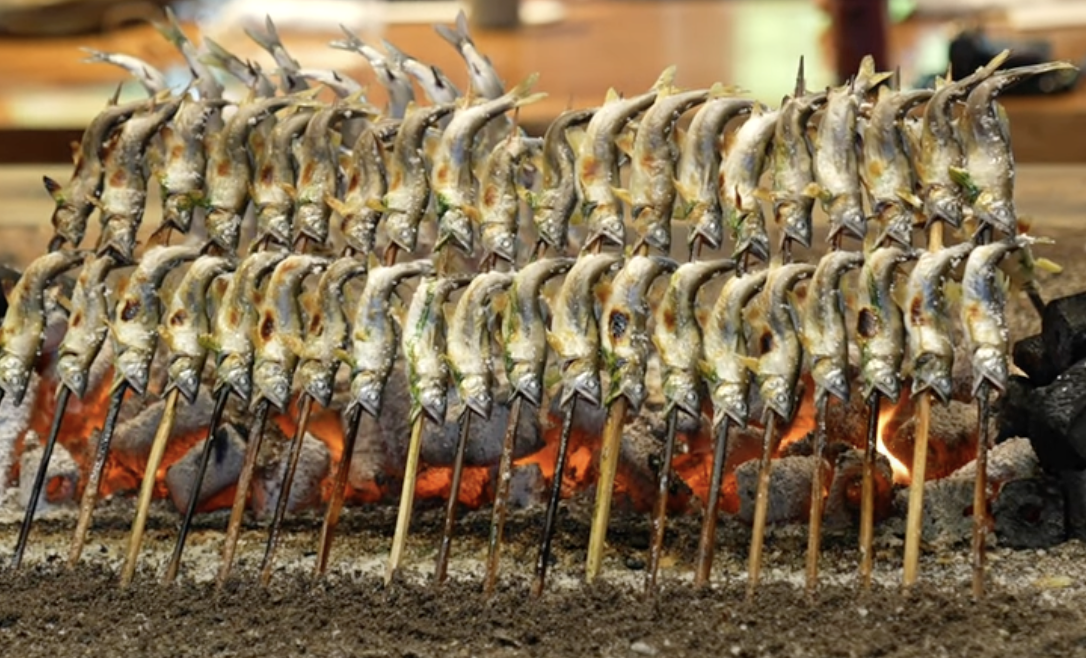
The Japanese style of cooking ayu (shown above) involves skewering the fish in such a way as fish are served up curved as though imitating a swimming fish even though it is clear to everyone that its swimming days are over! They can also be eaten as “sashimi” – raw with soy sauce or “tempura” – thinly battered and deep fried.
I realise I am guilty of doing something which I find very irritating myself, namely blabbing on about cooking, so let´s leave the fish on their skewers and get to know a little more about this modest East Asian fish.
Ayu do not grow very big for the simple reason that they do not live very long, often only one year. For the most part they spawn in little depressions in the gravel in the lower reaches of rivers in the autumn and the fry head downstream into the sea where they spend the winter in coastal waters before returning to the rivers in the spring. They are found in Japan, Taiwan (where pollution destroyed native stocks and Japanese fish were used for restocking), Korea, China, Hong Kong and Vietnam.
When I first saw an ayu fish close up (it was being cooked at the time) it brought to mind the brook trout of North America, having a sprinkling of white dots on the flanks and a big mouth. It is not related to trout at all or, for that matter, other familiar fish. Scientists have given it, not only a genus to itself, but also a whole family, Plecoglossidae. And also, unlike the trout that it superficially resembles, the ayu is predominantly herbivorous, feeding on algae that grow on the stones of the riverbed which it scrapes off with saw-shaped teeth.
So how do you go about catching a fish which is, basically, an underwater sheep? One way, of course is to use a cormorant which, though very cool, is not angling as you and I might think about it. The Japanese have come up with another method using a long rod and line but, as it happens, even this is not angling as you and I think about it.
The ayu are very aggressive and territorial and they will not tolerate another ayu muscling in on its little green pasture. It is this aggression that is exploited by the anglers. What the ayu fisherman does is, using a very long rod (these can be up to 10 metres long and cost a small fortune), attach a live ayu to their lines as a live bait. This is attached by a small ring inserted in the nose of the fish and from a keeper hook inserted around the anal fin a short length of line is attached onto which is ties a bare treble hook.
The fisherman swims or guides his live fish in a manner to search the water in front of him. If the baitfish swims too close to an ayu on its private patch of riverbed, it will be aggressively charged and the fish defending its homestead is likely to be hooked on the trailing treble hook. If all goes to plan the fish that had been acting as the “lure” is discharged of duty and placed into a container attached to the angler where he keeps his catch alive. The caught fish is then attached to become the target for the next ayu. Because the fish are small, a fisherman aims to raise the rod and swing both fish into the landing net. A Skilful ayu fishermen in this way can catch up to 50 or so fish in a day having started with only one live bait.
It is a personal thing, but live bait fishing is not for me and I am in the habit of returning all the fish I catch to the water. An ayu fishermen might say think that I am a mug and maybe he would be right. These ayu are short-lived fish that the fishermen understand that they are ultimately destined for the table. Wherever you stand on this, it is hard not to be impressed by the cunning shown in development of traditional methods that have been developed to catch a fish that would leave a fly fisherman like me simply shaking his head in bewilderment.


 fishydreams