
I caught a turtle on the fly yesterday which probably allows me to be considered among the world´s foremost authorities on fly fishing for reptiles. It has to be said that I had no intention of catching the thing and so I cannot pretend that this outcome was the result of focused effort or cunning strategy. What happened, as you can probably figure, is that I cast a fly out in the hope of catching a black bass when this dumb turtle showed up and decided it wanted to get in on the action.
I was casting from the float tube into a little clearing between a weed bed and the rushes on the margin. There were a few bass in there and I managed to extricate three or four before the turtle showed up. The bass that get hooked in that little clearing have to be manouevered through a heap of fronds of water plants that grow up to the surface and they bury themselves in foliage given half a chance. That is how things worked out for the turtle too. I had no reason to think that whatever I had to work out of the weeds was not another black bass until a web of fronds opened up and and revealed some weird looking head staring straight at me.
I don´t think that I have a future in turtle angling despite yesterday´s success. For the record, playing a turtle is pretty much like playing a rock with paddles attached which, very crudely, is what a turtle actually is. You can forget a screaming reel or praying you have enough backing and you can forget about searing runs, tail walking and head shaking leaps.
Maybe you have heard about some crazy trend out now for painting faces on stones? The internet is full of it. Some folks find them to be comforting companions and like to have them around. The faces painted on are, presumably, smiling. Far be it from me to pass disparaging remarks about people whose companions are painted rocks. As a float tube fly fisherman I am equally distantly removed from normality. But when my own animated rock emerged from the water yesterday its face was not smiling at all and I suspected that it was not particularly pleased to see me.
To be honest, I felt pretty bad about catching this thing and when it came to hand I apologised to it. I meant it too. But it has to be said that the turtle had taken the small popper fair and square and the rules of the game were upheld at all times by both of us. I did point this out at the time. Thankfully forceps were able to remove the barbless hook without any trouble and the turtle was soon on its way again.
Turtles seem to be very common here, which is good to see. Most abundantly seen is the Moorish or Spanish terrapin (Mauremys leprosa) also called the Spanish Pond Turtle or even the Mediterranean Turtle. Take your pick! As far as I know this is species is widely distributed from SW France, Spain, Portugal and NW Africa but I would be surprised if there were not regionally distinctive populations given their extensive range.
Turtle aside, the fishing yesterday evening was very good. I started with a sinking fly which a couple of bass liked the look of but there was movement in the marginal weeds that suggested the odd fish was moving at the surface, interested perhaps in dragonflies or their nymphs. So off came the sinking lure and in its place on went a popper and I probed the margins and breaks in the weed banks with it.
The bass were pretty keen on the popper and after a while I stopped counting how many I had taken. None were very big but I had a couple that, while still modest enough, were my best from this particular water. To be honest, with any kind of surface lure anyone would have scored well with those bass.
Yes. But what about with turtles?
Not likely! Turtle fishing is an art that requires true expertise. Most fisherman would simply not be up to the task.

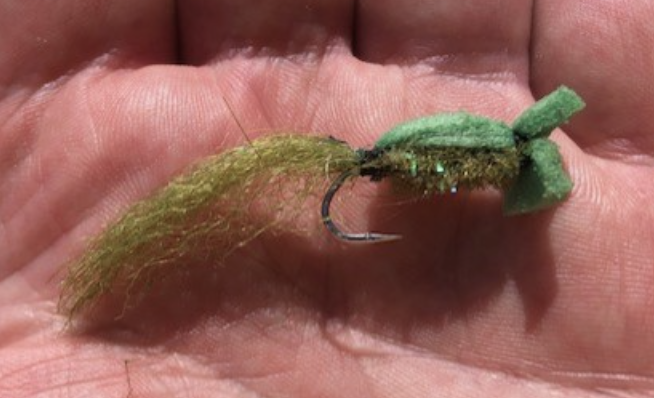
Turtle fly anglers everywhere will immediately recognise this pattern which I have found to be most successful!

 fishydreams